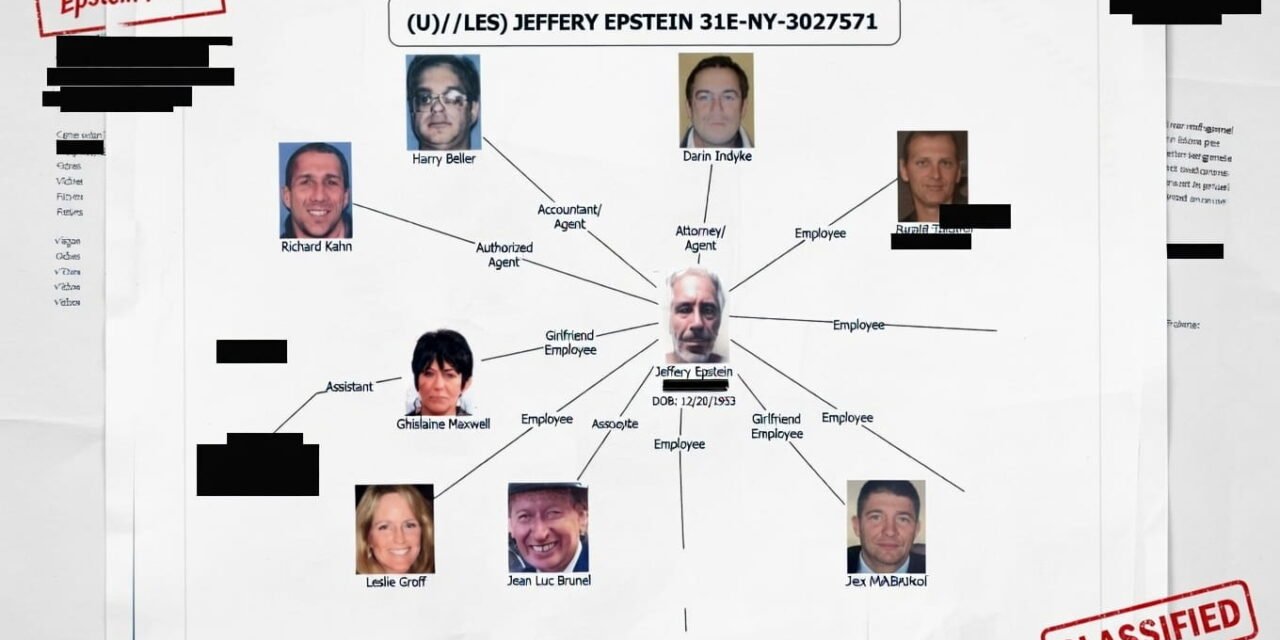
The Epstein Files represent one of the most significant document releases in recent U.S. history. On January 30, 2026, the Department of Justice released over 3.5 million pages of documents, 180,000 images, and 2,000 videos related to the investigation and prosecution of Jeffrey Epstein and his associate Ghislaine Maxwell. This massive trove includes court documents, emails, flight records, financial statements, and photographs that detail the criminal enterprise operated by the deceased sex offender.
The release came after bipartisan congressional pressure and the passage of the Epstein Files Transparency Act, which President Donald Trump signed into law on November 19, 2025. The House of Representatives voted 427-1 to pass the legislation, with the Senate approving it unanimously. This historic transparency initiative has ignited public interest while simultaneously raising important questions about victim privacy protection and the role of government oversight in high-profile criminal cases.
The Epstein Files Transparency Act: How It Started
The Epstein Files Transparency Act mandated that the Department of Justice release all unclassified documents, files, records, videos, and images related to Epstein’s investigations and prosecutions within 30 days of the law’s passage. The legislation represented rare bipartisan unity in Congress—only Republican Representative Clay Higgins cast a dissenting vote in the House, while the Senate passed the bill via unanimous consent. Trump signed the bill into law on November 19, 2025, setting a December 19, 2025 deadline for the initial release.
The act requires the DOJ to disclose:
- All unclassified records related to Jeffrey Epstein investigations
- All materials connected to Ghislaine Maxwell’s prosecution
- Flight logs and travel records for all vehicles owned by Epstein
- Names of individuals, including government officials, referenced in connection with Epstein’s activities
- Plea deals and internal DOJ communications related to the case
- Documents relating to Epstein’s imprisonment and death in 2019
Timeline: From Investigation to Document Release
The Epstein case spans two decades, from initial investigations through recent file releases. The timeline illustrates how long-standing concerns about justice finally crystallized into legislative action.
2005-2006: Palm Beach police began investigating Epstein after a parent reported he had sexually abused her 14-year-old daughter. Federal officials identified 36 girls, some as young as 14, whom Epstein allegedly sexually abused. The FBI formally opened an investigation called “Operation Leap Year” in May 2006.
2008: Epstein pleaded guilty to state-level charges of procuring a child for prostitution and soliciting a prostitute. He received 18 months in jail but served only 13 months due to a work-release program. This controversial plea deal, negotiated by U.S. Attorney Alexander Acosta, avoided federal prosecution entirely.
2019: Epstein was re-arrested in July on federal charges of sex trafficking minors. He died by suicide in a federal jail on August 10, 2019, while awaiting trial.
2020: Ghislaine Maxwell, Epstein’s longtime associate, was arrested and charged with facilitating sex trafficking.
2021: Maxwell was convicted in December on five counts, including sex trafficking of minors and conspiracy.
2022: Maxwell was sentenced to 20 years in prison on June 28, 2022.
2025: The House voted 427-1 and Senate unanimously passed the Epstein Files Transparency Act on November 18-19. Trump signed it into law, requiring DOJ release within 30 days. Initial releases began December 19, 2025.
2026: The Department of Justice released 3.5 million additional pages on January 30, 2026.
Key Events in Epstein Files Timeline
| Date | Event | Details |
|---|---|---|
| Nov 18, 2025 | House passes Transparency Act | Vote: 427-1 (only Rep. Clay Higgins opposes) |
| Nov 19, 2025 | Trump signs into law | Mandates release within 30 days |
| Dec 19, 2025 | Initial documents released | Includes some redactions; misses full deadline |
| Jan 30, 2026 | Major release | 3.5M pages, 180K images, 2K videos |
Notable Mentions from Flight Logs (Not Accused of Crimes)
| Name | Approx. Flights | Context |
|---|---|---|
| Donald Trump | 8 | 1990s family/social trips |
| Bill Clinton | 17+ | 2002-2003 Foundation work |
| Prince Andrew | Multiple | Visits to estates |
| Chris Tucker | 2+ | Humanitarian trips |
Epstein Network Roles (Key Figures)
| Name | Role | Legal Outcome |
|---|---|---|
| Ghislaine Maxwell | Recruiter/groomer | Convicted, 20 years |
| Jean-Luc Brunel | Model scout | Died in custody (2022) |
| Sarah Kellen | Scheduler | No charges |
Notable Passengers on Epstein’s “Lolita Express”
| Passenger | Approximate Flights | Key Dates | Notes |
|---|---|---|---|
| Donald Trump | 8 | 1990s (mostly) | Family trips to DC, NJ; socialized before falling out |
| Bill Clinton | 17+ | 2002-2003 | Post-presidency trips to Africa, Asia; Foundation work |
| Prince Andrew | Multiple | 1990s-2000s | Visited Palm Beach estate; settled civil suit 2022 |
| Chris Tucker | 2+ | 2002 | Clinton trips; AIDS initiative |
| Kevin Spacey | 1+ | 2002 | Clinton trip from USVI to PBIA |
Epstein’s Key Co-Conspirators & Roles
| Name | Role | Status |
|---|---|---|
| Ghislaine Maxwell | Recruiter, groomer | Convicted; 20 years prison |
| Jean-Luc Brunel | Model scout, trafficker | Died by suicide 2022 (French prison) |
| Sarah Kellen | Scheduler, photographer | No charges; interior designer |
| Lesley Groff | Executive assistant | No charges |
| Adriana Ross | Flight companion | No charges |
| Nadia Marcinkova | “Traveling companion” | No charges |
| Les Wexner | Financial backer | Cleared by attorney |
Epstein Files Release Timeline
| Date | Event |
|---|---|
| Nov 18, 2025 | House passes Transparency Act (427-1) |
| Nov 19, 2025 | Senate unanimous; Trump signs |
| Dec 19, 2025 | Initial release (missed full deadline) |
| Jan 30, 2026 | 3.5M pages, 180K images, 2K videos |
Who Was Mentioned in the Epstein Files
One of the most controversial aspects of the Epstein Files involves the names mentioned in the documents. Being named or photographed does not indicate wrongdoing or accusation.
Political Figures:
Trump’s name appears hundreds of times in the released documents. Trump has consistently denied any misconduct and has not faced charges related to Epstein. The two were friends before a falling out approximately 15 years prior to Epstein’s death.
Former President Bill Clinton appears in multiple photographs and flight records showing he took flights on Epstein’s private jet between 2002 and 2003. Clinton’s spokespersons clarified that these trips involved Clinton Foundation work, accompanied by staff and Secret Service.
Prince Andrew appears in released photographs but is not accused of crimes in the DOJ files. He previously settled a civil lawsuit with Virginia Giuffre in 2022.
Other political figures appearing in the files include former Treasury Secretary Larry Summers, former New Mexico Governor Bill Richardson, and former Senate Majority Leader George Mitchell.
Business and Technology Leaders:
Billionaire entrepreneur Elon Musk appears in photographs and email references. Tech investor Peter Thiel’s name appears in business correspondence. Microsoft co-founder Bill Gates is referenced in emails and photographs. Richard Branson, founder of Virgin Group, is pictured with Epstein.
Entertainment Figures:
Rock musician Mick Jagger, actor Kevin Spacey, entertainer Michael Jackson, and model Naomi Campbell appear in photographs. Filmmaker Woody Allen and photographer Peggy Siegal also appear in the files.
Academics and Public Intellectuals:
Philosopher Noam Chomsky appears multiple times in correspondence. Economist Alan Dershowitz, who was part of Epstein’s legal team in 2006, appears prominently in documents related to the non-prosecution agreement.
Important Note: Most individuals mentioned in released files are not accused of wrongdoing. Being named does not indicate involvement in Epstein’s crimes.
Understanding Epstein’s Criminal Enterprise
The Epstein files reveal in detail how a sophisticated criminal network operated to facilitate sex trafficking over several decades.
The Network Structure
Epstein built a layered organization designed to insulate himself from detection while facilitating systematic abuse. The criminal enterprise included recruiters, facilitators, enablers, support staff, and financial intermediaries.
The Recruiters: Recruiters targeted economically disadvantaged girls, often aged 14-18, from poorer neighborhoods. Recruiters, sometimes themselves victims, brought vulnerable minors to Epstein’s attention. Once girls joined the network, some received cash and gifts in exchange for recruiting other victims.
Ghislaine Maxwell: Maxwell served as Epstein’s closest associate and most culpable co-conspirator. She actively recruited victims through what prosecutors called the “grooming playbook.” Maxwell took girls shopping, offered to pay for education and travel, and developed personal relationships that built trust. Maxwell discussed sexual topics with victims, undressed in front of them to normalize sexual behavior, and was present during or participated in sexual acts. Her 20-year prison sentence reflects her participation in the abuse scheme.
Jean-Luc Brunel: A French modeling scout, Brunel founded MC2 Model Management with Epstein’s financial backing. Brunel used the modeling industry as a front for trafficking girls to Epstein. One victim alleged Epstein bragged he “had slept with over 1,000 of Brunel’s girls.” Brunel died by suicide in a French prison in February 2022 while facing rape charges.
Administrative Facilitators: Sarah Kellen arranged massage appointments that were in fact sexual assaults, escorted victims to abuse locations, photographed nude victims, and paid victims for photographs. Kellen is now an interior designer but has not faced criminal charges.
Support Staff: Alfredo Rodriguez, who worked as Epstein’s butler and property manager, described himself as a “human ATM” maintaining $2,000 in cash at all times to pay victims. He wiped down Epstein’s sex toys after visits, delivered gifts to victims including at their schools, and provided testimony during Maxwell’s trial.
Methods and Operations
Identifying Victims: Recruiters targeted girls from economically disadvantaged backgrounds lacking strong family connections, stable housing, or adequate financial resources.
The Grooming Process: Once identified, victims underwent a grooming process designed to build trust and normalize abuse. Epstein or Maxwell offered modeling opportunities, educational scholarships, or investment advice. Gift-giving reinforced relationships.
Normalization of Abuse: Victims were exposed to sexually explicit conversations designed to desensitize them. Maxwell’s undressing in front of victims and discussions of sexual preferences normalized what was in fact child sexual abuse.
The Massage Fraud: The actual abuse occurred under the pretense of “massage appointments.” Girls were told they would provide therapeutic massages in exchange for payment. Upon arrival, they found themselves in private rooms with Epstein where sexual contact occurred.
Payment System: After each abuse incident, victims received cash payments. These payments provided money to economically disadvantaged girls, created transactional relationships blurring the line between trafficking and prostitution, and incentivized victims to recruit other girls.
Operational Security: Epstein employed multiple layers of secrecy. Employees signed strict confidentiality agreements. Victims were discouraged from speaking with law enforcement, and if contacted, employees were instructed to notify Epstein’s attorneys—creating obvious conflicts of interest.
Facility Use: Epstein maintained multiple properties that facilitated the enterprise, including his Manhattan townhouse, Palm Beach mansion, New Mexico ranch, and private island in the U.S. Virgin Islands.
The Accidental Uncovering of Redacted Information
One of the most significant controversies surrounding the Epstein Files release involves failures in the redaction process. These failures revealed the technical challenges in managing massive document releases.
What Went Wrong
The initial December 2025 releases contained documents with faulty redactions. The DOJ used “black box” redaction, placing a visual layer over sensitive text. However, in PDF files, this technique does not permanently remove the underlying text. The text remains in the document’s data layer, recoverable through standard techniques.
Users quickly discovered that copying text from redacted areas and pasting it into new documents revealed the original text. PDF-to-text conversion tools could also extract the hidden information. This technique requires no advanced hacking skills.
The Victim Privacy Impact
Redaction failures had serious consequences for survivors. Attorneys representing hundreds of Epstein victims reported that clients discovered their names unredacted in publicly released files. Some individuals had never been publicly identified and had chosen not to come forward.
Brad Edwards, attorney for survivors, reported: “We are getting constant calls for victims because their names, despite them never coming forward, being completely unknown to the public, have all just been released for public consumption. It’s literally thousands of mistakes.”
The DOJ subsequently requested that victims’ attorneys flag unredacted victim names so documents could be pulled and corrected.
Professional Redaction Standards
Security experts noted that redactions violated established best practices. Professional redaction requires text layer removal, document regeneration, or conversion to images—not visual black boxes. Notably, a 2010 Department of Homeland Security memo specifically warned against the DOJ’s black box approach.
Contents of the Epstein Files: What Was Released
The January 30, 2026 release contained diverse materials spanning decades of investigation.
Documents and Correspondence
The release included over 3.5 million pages including:
- Court documents: indictments, plea agreements, trial transcripts, and sentencing memoranda
- FBI investigation files: interview summaries, witness statements, and investigative memos
- Email correspondence: thousands of emails to and from Epstein, Maxwell, and associates
- Financial records: bank statements, wire transfers, and accounting documents
- Grand jury transcripts: testimony from grand juries that indicted Epstein and Maxwell
Photographs and Video
The release included 180,000 photographs and 2,000 videos, encompassing:
- Personal photographs from Epstein’s homes
- Property photographs of his various residences
- Flight records documentation from his private jet
- Ghislaine Maxwell booking photographs with height and weight details
- Estate inventory photographs from search warrant applications
Flight and Travel Records
Flight records documented over two decades of travel and revealed an extensive network connected to Epstein.
What Was Withheld
The DOJ withheld certain materials under exceptions provided by the Epstein Files Transparency Act:
- Victims’ personally identifiable information
- Victims’ medical files
- Child sexual abuse material (CSAM)
- Images of death or severe injury
- Information related to active investigations or prosecutions
- Materials affecting national security
The DOJ reviewed documents with over 500 attorneys and reviewers to make redaction determinations.
Impact and Implications of the File Release
The Epstein Files release has had significant impacts across multiple dimensions.
Legal Implications
The release provides substantial new evidence regarding Epstein’s enterprise and law enforcement failures. Financial trails document money flows related to the enterprise. Government correspondence shows decisions to decline prosecution and limit investigation scope.
The released materials mention ten alleged co-conspirators, though most names remain redacted. Les Wexner, billionaire founder of L Brands, is named as among the identified co-conspirators, though his attorney states he has been cleared of wrongdoing.
Political Dimensions
Trump’s name appears hundreds of times in released documents. Trump asserts he knew nothing about Epstein’s crimes and has not been accused of involvement.
Bill Clinton appears in flight records and photographs. Clinton Foundation spokesperson clarified that trips involved Foundation work.
The Clintons have advocated for document release while declining to cooperate with congressional subpoenas, resulting in a House vote holding them in contempt.
Institutional Accountability
The files have prompted institutional review regarding law enforcement failures. The FBI’s 2006 investigation identified 36 potential victims but the case was narrowed through prosecutorial decisions.
U.S. Attorney Alexander Acosta’s decision to negotiate a minimal state-level plea deal despite federal evidence has been heavily criticized. The Department of Justice later concluded that Acosta violated victims’ rights by failing to inform them of the plea deal.
The Ghislaine Maxwell Appeal
Ghislaine Maxwell continues to pursue legal remedies after her conviction. Maxwell was convicted in December 2021 of five counts and sentenced to 20 years in prison on June 28, 2022. In December 2025, she filed a habeas corpus petition arguing that newly discovered evidence warrants reconsideration of her conviction.
In her filing, Maxwell alleges jury bias, improper coordination between prosecutors and victims’ attorneys, exculpatory evidence in the Epstein Files, and that four unindicted co-conspirators should have been charged. Maxwell also alleged the DOJ reached “secret settlements” with twenty-five men not prosecuted in connection with Epstein’s enterprise.
Conclusion
The Epstein Files represent the largest-scale government transparency initiative regarding a criminal sex trafficking enterprise. The 3.5 million documents, 180,000 images, and 2,000 videos released in January 2026 provide unprecedented detail about Epstein’s operation, the network that facilitated abuse, and the government’s investigative response.
While the files have generated significant public interest and controversy, they have also created new challenges regarding victim privacy protection and institutional accountability. The redaction failures underscore the technical complexity of managing massive document releases. The ongoing legal battles involving Maxwell and other potential co-conspirators suggest that legal consequences remain incomplete.
For survivors, the legal system, law enforcement agencies, and the public, the Epstein Files provide important documentation of a criminal enterprise while raising urgent questions about preventing such systematic abuse in the future.
FAQs
What are the Epstein Files?
The Epstein Files are over 3.5 million government documents released by the U.S. Department of Justice on January 30, 2026. They include court records, emails, flight logs, photos, and videos from investigations into Jeffrey Epstein’s sex trafficking network. The release followed the Epstein Files Transparency Act signed by President Trump in November 2025.
When were the Epstein Files released?
Major release: January 30, 2026 (3.5M pages). Initial batch: December 19, 2025. The process started after Congress passed the Transparency Act on November 18-19, 2025.
Who was on Epstein’s flight logs?
Flight logs name Donald Trump (8 trips, 1990s), Bill Clinton (17+ trips, 2002-2003 for Foundation work), Prince Andrew (multiple), and Chris Tucker (2+). Being listed does not mean wrongdoing.
What caused redaction failures in Epstein Files?
Documents used “black box” PDF redactions that hid text visually but allowed easy extraction via copy-paste or PDF tools. This exposed victims’ names unintentionally.
Who are Epstein’s main co-conspirators?
Key figures: Ghislaine Maxwell (convicted recruiter), Jean-Luc Brunel (model scout, deceased), Sarah Kellen (scheduler, no charges). Ten named total in files.
Did Epstein have a client list?
No comprehensive client list was found in the files, according to DOJ. Mentions refer to associates, not a formal paid client roster.
Why was Maxwell convicted but others not?
Maxwell directly recruited and groomed victims. Prosecutors focused on her due to strong evidence; others like Kellen lacked sufficient proof for charges.
What does Transparency Act require?
It mandates DOJ release all unclassified Epstein/Maxwell records, including flight logs, names of officials, and plea deals, while protecting victims.
How many victims were identified?
Early FBI probe (2006) identified 36 girls, some as young as 14. Files reference hundreds affected over decades.
What’s next for Epstein case?
Maxwell appeals her conviction. Victims pursue civil suits. Calls continue for investigating uncharged co-conspirators.v