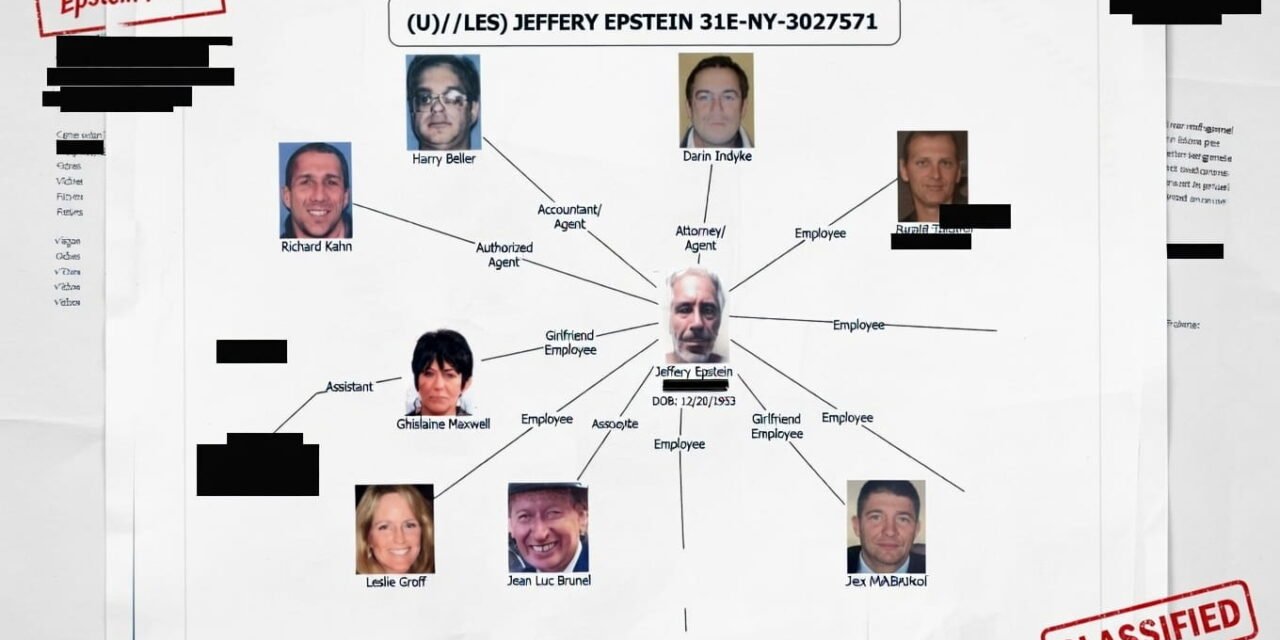
When the U.S. Department of Justice released over 3 million pages of Jeffrey Epstein files on January 30–31, 2026, the document dump rippled far beyond American borders. Buried within this unprecedented tranche of investigative materials—emails, text messages, calendars, and interview notes—lay references to India’s Prime Minister Narendra Modi, billionaire businessman Anil Ambani, and a web of alleged diplomatic backdoor arrangements that have left India’s political establishment scrambling to contain a scandal it insists doesn’t exist.
The Epstein revelations on India centers on correspondence between the late convicted sex offender and financier and Indian business and political figures between 2014 and 2019. While none of the named Indians are accused of involvement in Epstein’s criminal activities—child sex trafficking and abuse—the documents suggest Epstein positioned himself as an unofficial intermediary with remarkable access to India’s top leadership. For a country fiercely protective of its sovereignty and diplomatic narrative, the implication that a disgraced American financier may have influenced foreign policy decisions has triggered urgent denials and political recriminations.
The January 2026 Megadump: Context and Scale
The release stems from the Epstein Files Transparency Act, passed by Congress in November 2025 with bipartisan support. This legislation mandated the complete declassification and public release of all federal documents connected to the Epstein investigation. The Justice Department, under Deputy Attorney General Todd Blanche, initially missed a December 19 deadline but ultimately published materials across January 2026, including over 3 million pages, thousands of videos, and thousands of images.
The delayed and staggered release sparked criticism from multiple quarters. Some observers accused the Trump administration of moving too slowly or withholding sensitive materials. Others questioned why certain documents were redacted to protect the identities of alleged victims while highly sensitive political correspondence remained largely unredacted. What emerged was a chaotic archive: partly organized investigative files interspersed with unvetted public tips, FBI interview notes, and private communications spanning decades of Epstein’s operation as a power broker among global elites.
Within this massive archive, the Indian connections surfaced quickly. The Epstein revelations on India immediately became headline fodder in Indian media, with outlets like The Wire, The News Minute, and Al Jazeera publishing detailed reconstructions of the correspondence. What they found was striking enough to warrant diplomatic statements from India’s Ministry of External Affairs—a rare occurrence for matters dismissed as merely tangential to a criminal investigation.
The Anil Ambani Connection: A Billionaire as Unofficial Ambassador
Anil Ambani, the elder brother of India’s wealthiest individual Mukesh Ambani and chairman of Reliance Group, emerges from the files as a central figure in Epstein’s diplomatic outreach to India. Ambani is not only one of India’s most influential businessmen but also a close associate of Prime Minister Modi—a relationship that has spanned decades and forms a cornerstone of the Reliance-Modi political alliance.
The documents reveal email and text exchanges between Ambani and Epstein spanning from 2017 to May 2019, just six weeks before Epstein’s arrest on federal charges of sex trafficking minors. These weren’t casual communications; they focused on matters of state: Modi’s planned visits to the United States, India’s emerging relationship with Israel, geopolitical strategy regarding China and Pakistan, and American political access.
In March 2017, according to The Wire’s analysis of the files, Ambani emailed Epstein asking about Prime Minister Modi’s planned Washington visit. “Can u tell me when and the dates?” Ambani wrote. Days later, he followed up: “Any visibility on dates of our pm visit to dc?” He also inquired about “track 2” contacts—diplomatic terminology for unofficial, backchannel negotiations.
Epstein’s cryptic response: “India Israel Key – not for email.” This single sentence carries significant weight: it suggests Epstein understood himself to be involved in sensitive discussions about India’s evolving defense and strategic relationship with Israel, a geopolitical realignment that would become public when Modi visited Israel in July 2017—the first Indian prime minister ever to do so.
The correspondence between Ambani and Epstein also touched on broader geopolitical concerns. In messages, Epstein reported back from “White House discussions” with updates on American positions regarding Israel. He noted that Modi’s team seemed preoccupied with India’s relationship with Israel, even as other internal conflicts consumed bandwidth.
Later, Epstein reported that Modi “did well in St. Petersburg,” referencing Modi’s attendance at the St. Petersburg International Economic Forum in June 2017, and noted that “India still not pinned down” on certain Trump administration policies.
The most contentious revelation came on May 23, 2019—the very day Modi’s election victory was announced. On that day, Epstein met with someone he described as a Modi representative in New York. The New York Times and Dropsite News initially reported on this meeting; the DOJ files confirm Epstein’s own account.
After the meeting, Epstein messaged Steve Bannon, Trump’s former chief strategist, with explosive language: “Really interesting modi meeting. He [Modi’s representative] with mandate. guy said no one in Washington speaks to him, however, main enemy CHINA And their in the region is Pakistan. They will host the G20 in ’22… Totally buys into your vision.”
Moments later, Epstein declared: “Modi on board.”
This phrase has become the symbolic centerpiece of the Epstein revelations on India, repeated endlessly in Indian media and opposition commentary. It suggests Epstein had successfully convinced Modi’s circle to align with Bannon’s geopolitical worldview—which emphasized U.S.-India coordination against China. Yet the full record raises a troubling question: Did Anil Ambani have the authority to commit Modi to such a position? The documents provide no clear answer.
The Israel Visit and the “Danced and Sang” Claim
Perhaps the most inflammatory revelation involves Modi’s historic visit to Israel in July 2017. On July 6, 2017—the final day of that visit—Epstein sent an email to a contact in Qatar that read: “The Indian Prime minister modi took advice. and danced and sang in israel for the benefit of the US president. they had met a few weeks ago.. IT WORKED.!!”
The language is striking and inflammatory. Epstein’s claim suggests that Trump had advised Modi on how to conduct the Israel visit, and that Modi had deliberately performed displays of cultural affinity in Israel specifically to impress Trump, with Epstein framing the exercise as a calculated success.
The timing is significant: Modi had met Trump in Washington on June 26, 2017, just one week before departing for Israel. The visit itself was historic—Modi became the first Indian prime minister to visit Israel in an official capacity, a dramatic reversal of decades of Indian foreign policy that had historically subordinated relations with Israel to solidarity with the Palestinian cause.
India’s Ministry of External Affairs responded swiftly. In a statement on January 31, 2026, the MEA said: “We have taken note of reports of email messages from the Epstein Files referring to the Prime Minister and his visit to Israel. Except for the prime minister’s official visit to Israel in July 2017, the rest of the references in the email are nothing more than trash rumours of a convicted criminal. These should be dismissed with the utmost contempt.”
The government’s position is legally defensible: Epstein was a convicted sex offender whose credibility is compromised. The claims are unsubstantiated. Modi’s Israel visit was announced through official channels and served India’s strategic interests independent of any American influence. Yet the statement’s harshness—using the word “contempt” repeatedly—suggests deep political discomfort with the narrative now in the public domain.
Hardeep Singh Puri: The Diplomat in Epstein’s Network
Another Indian figure occupies surprising prominence in the Epstein files: Hardeep Singh Puri, currently India’s Minister of Petroleum and Natural Gas and a senior BJP leader. Puri’s connection to Epstein predates his entry into government, spanning 2014 to 2017, when Puri was based in New York working for the International Peace Institute (a UN-affiliated think tank) and serving as a UN diplomat.
The email exchanges reveal Epstein’s efforts to connect Puri with Silicon Valley entrepreneurs, particularly LinkedIn co-founder Reid Hoffman. In June 2014, Epstein informed Puri that Hoffman was interested in visiting India. The two men met in person—at least four confirmed occasions at Epstein’s Manhattan residence, including in April 2015 and January 2017. Puri crafted detailed proposals for Hoffman outlining investment opportunities in India’s nascent internet sector under Modi’s “Digital India” initiative.
In a November 13, 2014 email, Puri pitched Hoffman on India’s internet economy, noting that India’s user base had reached 200 million, growing by 5 million monthly, with projections to reach 500 million by 2018. He highlighted Modi’s policies on innovation and “Make in India,” and drew comparisons between LinkedIn’s 28 million Indian resumes and local competitor Naukri.com’s 38 million. Hoffman responded warmly, and the two maintained contact.
Puri has since defended these interactions as purely business-oriented, emphasizing that they preceded his entry into the Modi government in September 2017. “In 2014, I was saying, this government will concentrate on innovation, this government will do Make in India, and LinkedIn has 28 million—mentioned India’s regional languages, this could have potential,” he told The Wire.
He stressed that he cut off contact with both Epstein and Hoffman once he joined government and once he learned the extent of Epstein’s criminality. The BJP has also pointed out that Epstein misspelled Puri’s name in some documents, suggesting the relationship was less significant than headlines imply.
Nonetheless, the fact remains: a senior Indian minister engaged in sustained business networking with a convicted sex offender who was simultaneously cultivating back-channel access to India’s government. Even if no impropriety occurred, the optics are uncomfortable.
The Broader Epstein Network: Trump, Bannon, and Global Influence
The Indian revelations are part of a larger picture of Epstein’s reach into global power structures. The 3 million-page release shows Epstein mentioned more than 1,000 times in relation to Trump alone, with extensive correspondence between Epstein and Steve Bannon. The files also document Epstein’s connections to Bill Clinton, Elon Musk, Bill Gates, and dozens of other prominent figures across politics, business, academia, and media.
What emerges is a portrait of Epstein as a professional connector—someone who placed himself at the intersection of wealth, power, and influence, offering access, counsel, and strategic positioning to figures who sought his services.
This role persisted even after his 2008 conviction for soliciting prostitution from a minor in Florida, which left him a registered sex offender. That he maintained his position in elite circles despite this status is itself a revealing indictment of institutional accountability and power dynamics among the global elite.
What’s Proven, What’s Alleged, and What Remains Unclear
A crucial distinction must be drawn: the Epstein files document what Epstein claimed, not necessarily what actually happened. Epstein was a serial liar and fabricator who exaggerated his access and influence. The phrase “Modi on board,” for example, may have been Epstein’s interpretation of a conversation with an intermediary—a projection of significance onto a meeting that may have been far less meaningful.
| Key Claim | Status | Evidence |
|---|---|---|
| Ambani-Epstein communication about Modi’s priorities | Confirmed | Email and message exchanges, calendars |
| May 23, 2019 meeting between Epstein and Modi’s representative | Documented | Epstein’s own account and calendar; unclear who attended |
| Modi-Trump influence on Israel visit | Alleged by Epstein only | Single July 6 email; no corroborating evidence |
| Hardeep Puri business networking with Epstein | Confirmed | Email exchanges, meeting confirmations |
| Any criminal misconduct by Indian figures | Not alleged | No such accusations in documents |
The files show that Epstein sought to position himself as an intermediary and that he achieved some level of access to Indian business and diplomatic circles. What they do not show is that Modi was corrupted, influenced to alter policy decisions, or complicit in any wrongdoing.
Modi’s Israel visit had legitimate strategic rationales independent of any American encouragement. India’s foreign policy decisions are made through formal government channels, not through the whispering networks of international financiers.
Yet the revelations do raise uncomfortable questions about how power operates globally, about the informal networks through which influence flows, and about the degree to which figures like Epstein can insert themselves into matters of state through calculated relationship-building and strategic hospitality.
Government Denials and Opposition Demands
India’s government has been categorical in its denials. The Ministry of External Affairs statement characterized the references as “trashy ruminations by a convicted criminal” deserving “utmost contempt.” Government spokespersons have emphasized that Modi never met Bannon as Epstein claimed, that the Israel visit was an official decision made through proper channels, and that Epstein’s assertions carry no evidentiary weight.
The Indian opposition, particularly the Congress party, has taken a different tack. Rather than dismissing the files entirely, Congress leaders have demanded clarity. “What advice? Why dance and sing to please Trump?” asked opposition figures in Indian parliament. Congress leader Pawan Khera called for the government to publicly explain the nature of interactions between Ambani and Epstein, and whether there was any quid pro quo in India’s diplomatic decisions.
This opposition pressure reflects a broader political calculation: while the Epstein files contain no smoking gun implicating Modi in criminal conduct, they do suggest a degree of informality, opacity, and reliance on private intermediaries that conflicts with the government’s carefully curated image of institutional propriety. In Indian politics, the appearance of impropriety—even absent actual misconduct—can be weaponized.
What the Epstein Revelations on India Mean for Foreign Policy and Diplomacy
The Epstein revelations on India illuminate several uncomfortable truths about contemporary geopolitics. First, informal networks and unconventional channels persist as mechanisms for diplomatic communication, even in the age of official government structures.
Ambani’s willingness to convey messages between Epstein and Modi’s circle, and Epstein’s confidence in his ability to broker introductions between Modi and figures like Bannon, suggest that formal diplomatic protocols remain supplemented—and sometimes circumvented—by private relationships among elites.
Second, the files demonstrate that even disgraced or compromised individuals can maintain access to power if they possess valuable networks or strategic positioning. Epstein’s status as a convicted sex offender did not insulate him from engagement with figures in Indian government and business; instead, his continued access itself becomes a liability, opening Modi’s government to accusations of poor judgment or worse.
Third, the Epstein revelations on India highlight the vulnerability of emerging powers to influence peddling by sophisticated actors. India’s rapid rise has created opportunities for figures like Epstein to insert themselves as supposed connectors between Indian leadership and American establishment figures—a role that feeds Indian leaders’ desire for access and legitimacy while advancing Epstein’s own status and business interests.
Conclusion: The Limits of Transparency and the Persistence of Opacity
The release of the Epstein files represents an extraordinary exercise in transparency, yet it also reveals the limits of document disclosure as a tool for truth-seeking. The 3 million pages contain evidence of meetings, correspondence, and intentions, but they do not resolve the fundamental question of what actually happened in private conversations. Epstein’s characterizations of events may be self-aggrandizing fabrications. Modi’s government’s denials may be defensible.
What remains undeniable is that Jeffrey Epstein successfully cultivated relationships with figures in India’s political and business elite, positioned himself as a connector between Indian and American interests, and maintained those relationships even as his criminal record became public knowledge. Whether this altered India’s foreign policy decisions, whether Ambani acted on Modi’s authority, whether Trump actually influenced Modi’s Israel visit—these questions may never be fully resolved.
The Epstein revelations on India serve as a reminder that power operates through networks both visible and hidden, that transparency initiatives can expose inconvenient connections without necessarily resolving their significance, and that even in democracies, the lines between formal governance and informal influence remain blurred.